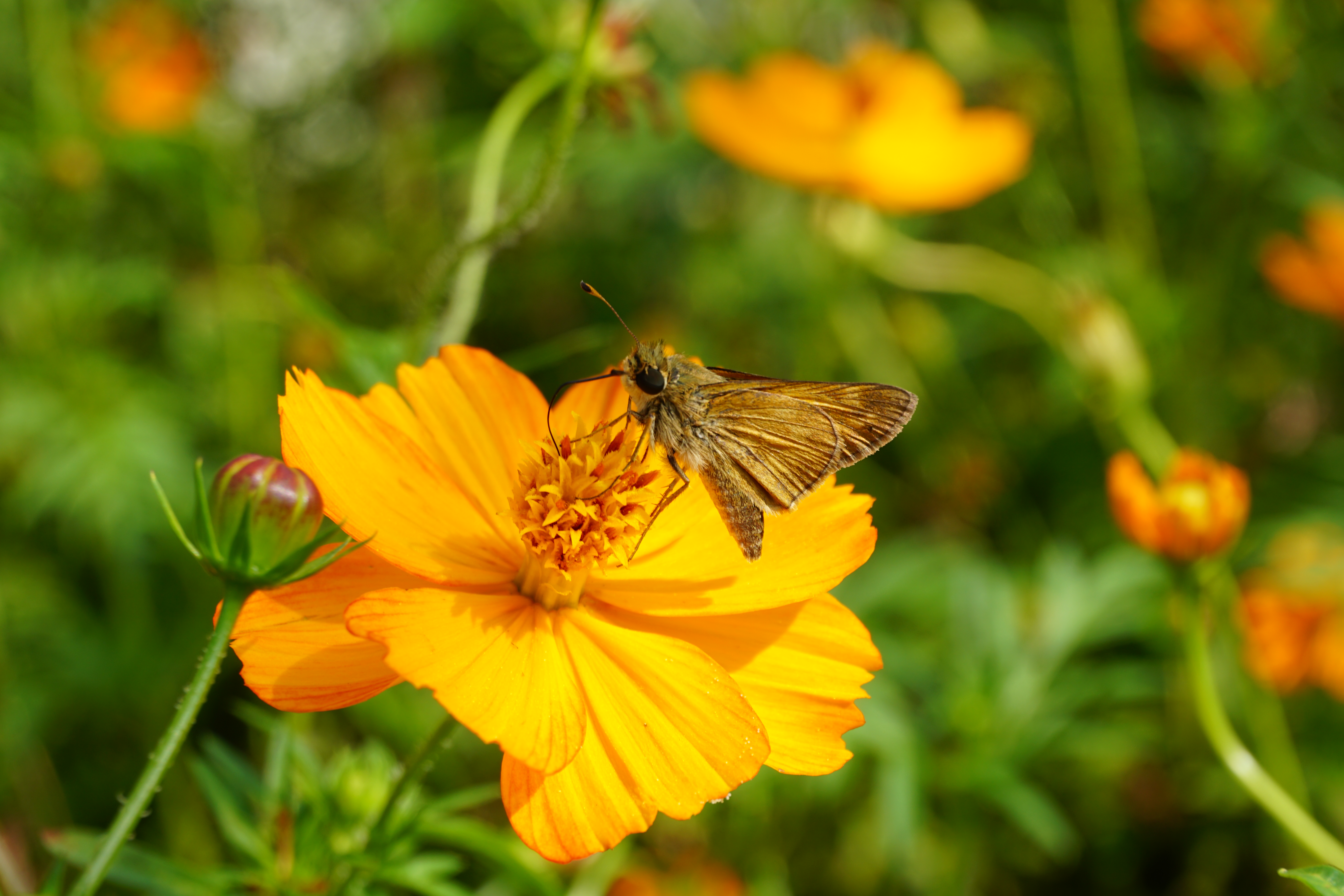
For most of this week the cosmos patch has had company. Small, fast-moving, the color of varnished wood — something that reads as a moth at a glance and a butterfly a half-second later, once it lands and holds its wings at that stiff, half-open angle nothing else quite manages. It took three afternoons of watching before it sat still long enough to be looked at properly rather than just noticed. It is a sachem, Atalopedes campestris, and it turns out to be a much better subject for close attention than for a quick glance.
Sachems belong to the skippers, family Hesperiidae — the stocky, big-eyed, short-winged relatives of the butterflies proper, named for the way they don’t so much fly as skip: a quick low burst between flowers rather than a glide. The body is heavier than a butterfly’s relative to the wing, the antennae end in a small hooked club instead of a simple knob, and the flight is fast enough that most of what you learn about one happens after it has already landed.
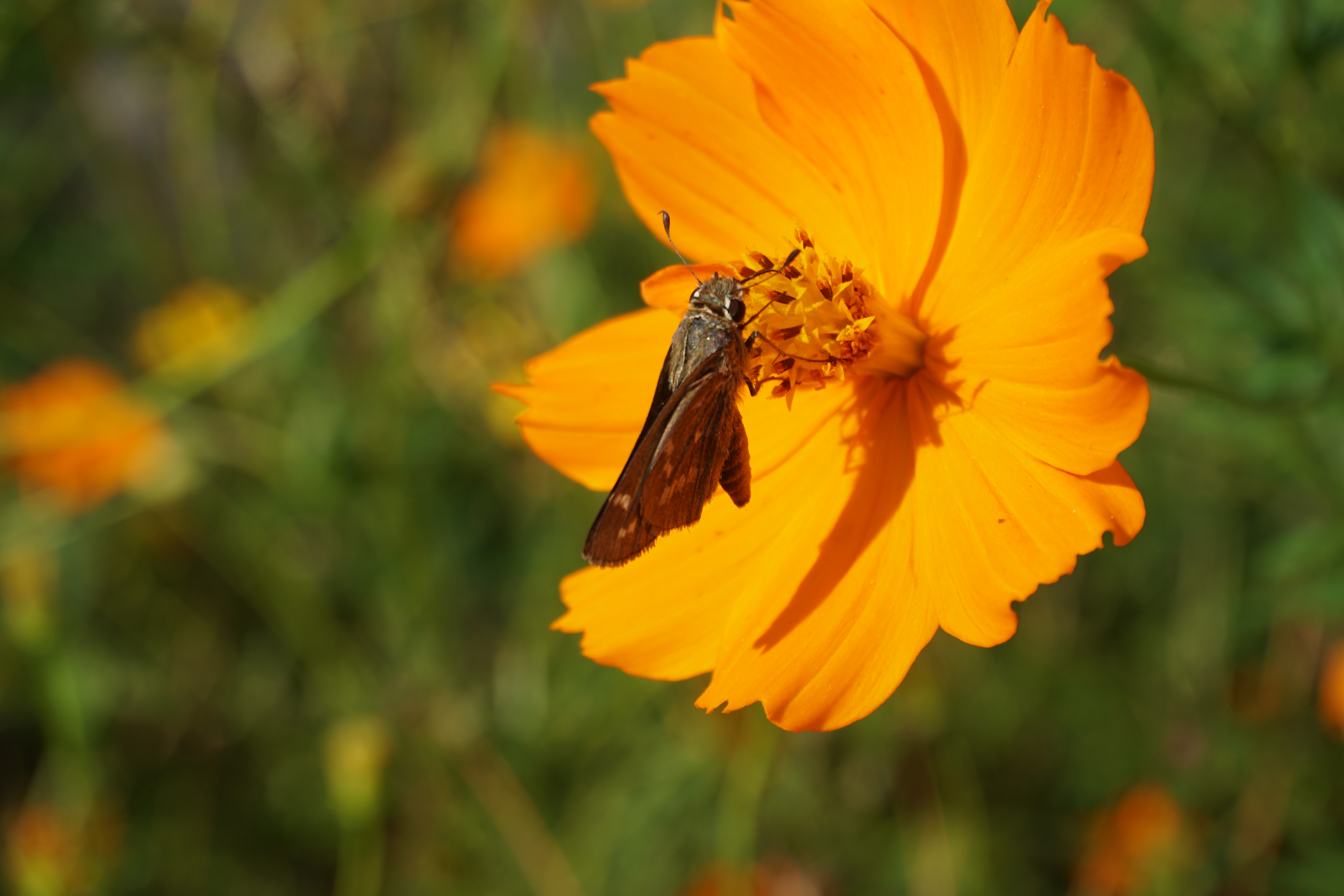
Wings closed, as above, a sachem is a fairly plain study in brown and dun, easy to overlook against dead grass. Wings open is a different matter — a wash of tawny orange bordered in dark brown, with a squared-off black mark sitting across the middle of each forewing. That mark is a stigma, present only on males, made of specialized scent scales rather than ordinary pigment.1 Females never show it; theirs is a darker, more variable wing with a small pale, almost window-like spot near the tip of the forewing instead, which is usually the faster way to sex one at a glance than trying to find the stigma’s absence.
What’s pictured at the top of this post — wings fully spread, stigma plainly visible — is a male, sunning or simply pausing between visits to the flower head. Baldly perching on open ground or low grass in full sun is typical behavior for males of this species, not just a photogenic accident; they use conspicuous, sunlit perches to watch for passing females; the whole strategy depends on being seen, which happens to make the pose convenient for anyone else with a camera.
Until fairly recently this account would have covered a much larger range than it does now. A 2022 taxonomic revision split what had been treated as one wide-ranging species into two, carving out the eastern North American population as its own species, Atalopedes huron, and leaving A. campestris to the western and southern populations, south through Mexico and Central America into Colombia, Venezuela, Ecuador, and Brazil.2 The two look close to identical in the field; telling them apart reliably is mostly a matter of where you’re standing when you see one.
Even the narrower range isn’t fixed. In the warmer months adults push north well beyond where the species can overwinter — as far as Montana, Washington, and New York have all recorded them — before that population dies back with the cold and the range contracts south again the following year. The interesting part is why: researchers tracking the expansion attribute it to a warming climate loosening the limits of the growing season, not to the butterfly itself evolving any new tolerance for cold.3 It is, in other words, a species getting to visit more of the map without actually changing.
None of this requires anything unusual underfoot. Sachem caterpillars eat grass — ordinary lawn and pasture grass, the kind that gets mowed rather than planted on purpose: bermudagrass, crabgrass, fescue, St. Augustine, goosegrass, saltgrass among others. The adult nectaring at a cultivated flower bed is, more likely than not, a few dozen feet from the exact clump of turf it grew up eating.
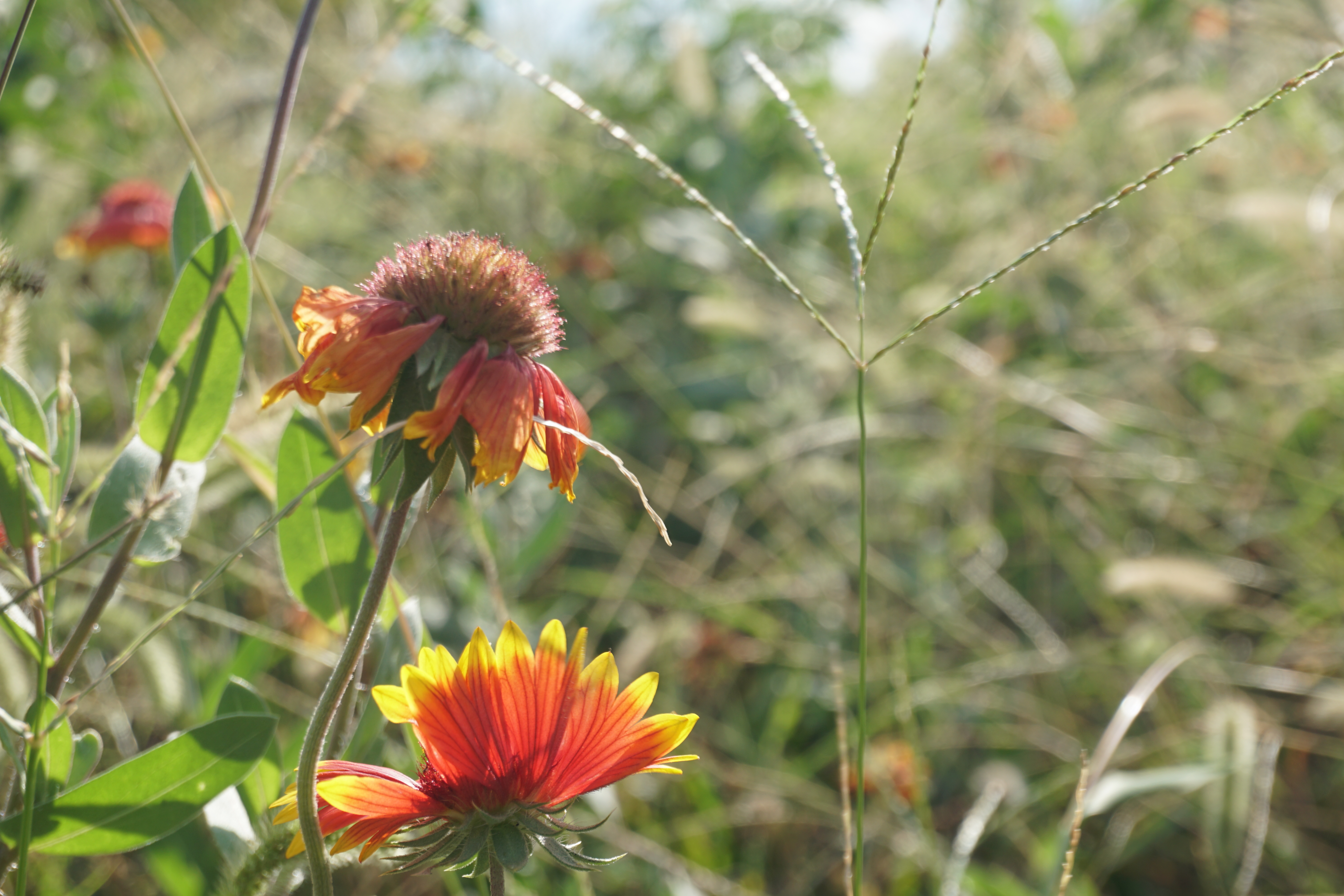
The photo above shows none of the butterflies themselves — it’s the bed itself, blanketflower going to seed beside the kind of coarse grass that is doing the actual work of raising the next generation while the flowers get all the attention. It felt worth including precisely because it’s the less photogenic half of the same story: a sachem’s whole life cycle, egg to adult, plays out across two completely different diets in the same few square feet of ground.
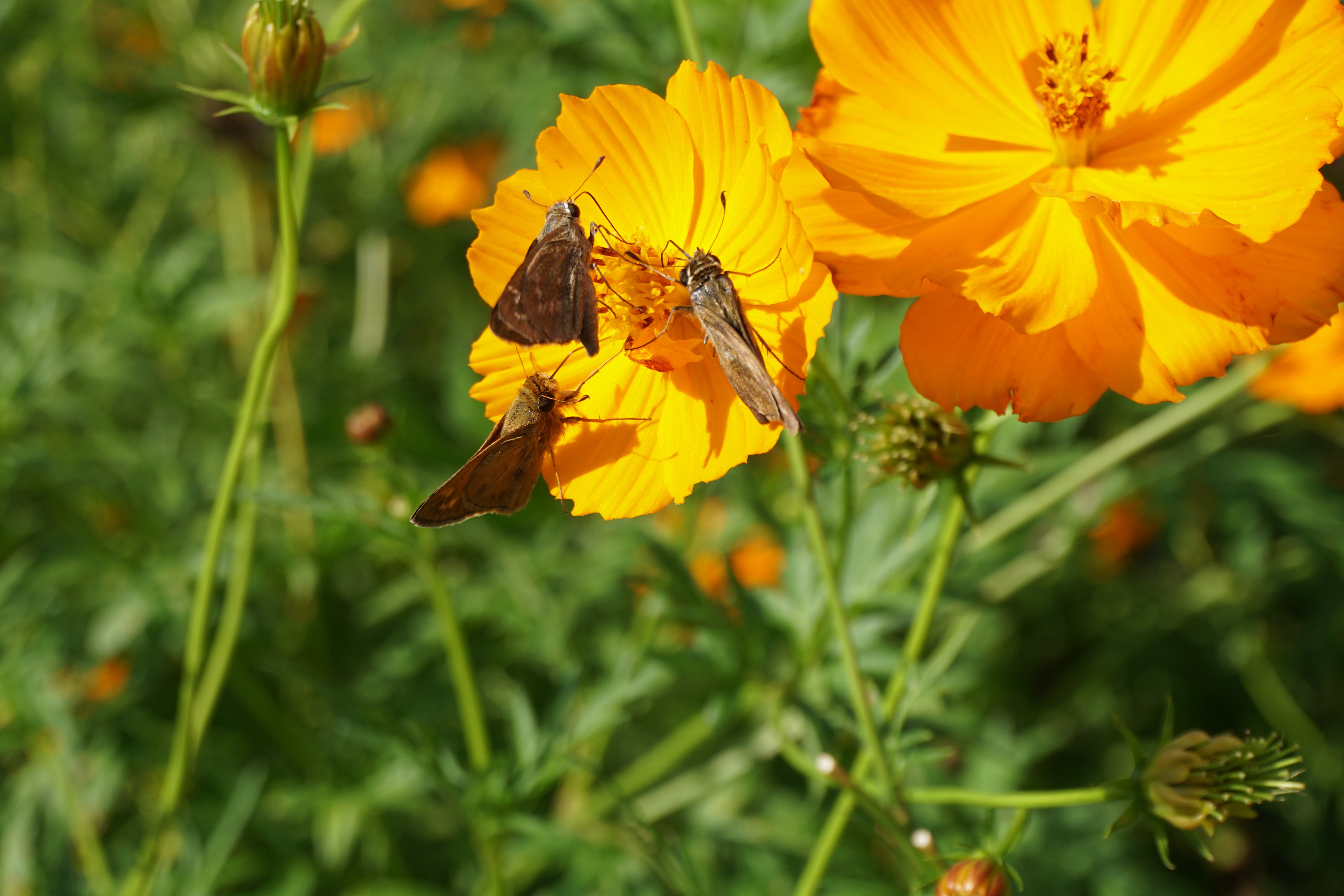
By the second afternoon there were three on one flower head at once, which is more than territorial perching behavior alone would predict. A male holding a favored perch is defending it from rivals, not inviting a crowd — but a single rich bloom in a bed with a few dozen competing for attention is apparently worth the truce. They jostled for maybe a minute, wings occasionally brushing, before two peeled off toward the next flower over and left the third alone with what it had been working the whole time.
It’s a small, common, faintly overlooked insect — not rare, not threatened, not the reason anyone plants a cosmos bed. But paying it the kind of attention usually reserved for something rarer turns out to be its own reward: a stigma that means something specific, a species boundary that moved in 2022, a range that breathes in and out with the seasons, two unrelated plants doing two unrelated jobs for the same animal. All of that was sitting in a flower bed that gets walked past daily without a second look.4
-
The stigma is a patch of modified androconial scales — scent scales — used to disperse pheromones during courtship, which is why it only shows up on males. See the Wikipedia entry for Atalopedes campestris for more on the wing pattern differences between the sexes. ↩
-
The split is recent enough that a lot of older field guides and range maps still describe one species where there are now technically two. Nothing about the butterfly changed in 2022 — just where the line on the map got drawn. ↩
-
More on the seasonal range expansion, habitat, and host plants — including the Pacific Northwest end of that range, well north of where this species can survive the winter — at Butterflies of Oregon’s sachem page. ↩
-
For more on paying close attention to something easy to walk past, see Grain, Stored, on a stretch of grain silos most people driving past never really look at either. ↩